What to write on your wedding website: a checklist
You picked a design in ten minutes and then stared at an empty box for four days. Here is what goes in each one, and starter text you can edit.
Choosing the design took ten minutes. Then you opened the first empty box, the one labelled invitation message, and you have been looking at it for four days.
Below is every section of a wedding website, what it is for, what to put in it, and starter text you can copy and change. The order is roughly the order a guest reads in, and it maps onto the boxes you fill when you build one with us.
Your names on a wedding website, and how to write them
First names only. The surnames go in the families section, where they belong, and a cover carrying four names looks like a legal document.
Pick a spelling and hold it everywhere. If your name has two accepted spellings, and most of ours do, choose the one that will be on the printed card and use it on the website, the link, the hashtag and the share preview. A guest who searches for Ankita and finds Ankitha assumes they have the wrong wedding.
Order matters less than consistency, but decide it once. Whichever name goes first on the cover should go first everywhere else, including the address of your site.
Your link is read out loud
The invitation line
One short paragraph that says who is inviting, and to what. It is the box people leave for last, and the first thing the older half of your guest list will actually read.
The decision is whose voice it is in. If your parents are hosting, as they usually are, let the line say so. The version where the couple invites everyone in their own voice reads modern and lands badly with a lot of elders, who will read the absence of the families as a statement.
Together with their families, [Name] and [Name] request the pleasure of your company as they begin their life together.
We are getting married, and we would very much like you there. [Name] and [Name] [Date], [City]
If your family follows a particular form, there are longer examples of invitation wording by tradition to start from instead.
Families, and the sign-off at the end
Getting a parent's name wrong on an invitation is not a typo. It is a story your family tells at weddings for the next fifteen years. This section deserves more care than the photos and gets less.
Ask each set of parents how they write their own names, in writing, and copy it exactly. Not what you call them. Not what is on the PAN card. The form they use on invitations: Mr and Mrs, or Shri and Smt, with or without the middle name, with the honorific your family actually uses. Send the draft to one parent on each side before you publish and let them correct it.
For a parent who has passed away, the convention in most families is to keep the name and mark it, usually as Late Shri or Late Smt. Do not decide this on your own. Ask whoever is senior in that family which form they use, because the alternative, leaving the name out to avoid the question, is the version that hurts.
Grandparents are optional and worth including when they are alive and involved. Seeing their own name on their grandchild's invitation matters more to them than any design choice you will agonise over. Our families section has a grandparents block you can switch on.
Then the sign-off at the end of the invitation, which is where the phone numbers go. Not yours. You will be unreachable for three days and asleep for two of them. Put one number per side, belonging to a brother, a cousin or an uncle who has agreed to it out loud, and label who they are so a guest knows which one to ring about the Delhi bus and which one about the hotel.
With the blessings of our elders and the love of our families, we invite you to share these days with us.
Awaiting your gracious presence, the [Surname] and [Surname] families [Name], brother of the bride: [phone] [Name], cousin of the groom: [phone]
The events, which is the part guests actually use
Everything else on your website is read once. This section is opened in the car, in the lift, and at the venue gate.
Every function needs five things, and most invitations ship missing the fifth.
| Field | What to write | Why guests need it |
|---|---|---|
| Name | Sangeet, Haldi, Pheras, whatever your family calls it | So it matches what they hear from everyone else |
| Day and date | Friday, 12 December, not just 12/12 | Half your guests are booking leave around it |
| Time | The time you want people seated | See the note below, this one is a trap |
| Venue | Name, area, city | Enough to recognise, not a full postal address |
| Map link | A Google Maps pin | The field that stops the calls on the day |
The timing trap. Everyone knows the printed time is not the real time, so guests apply their own correction and arrive an hour late, which means you print an earlier time, which means they correct harder. It escalates every wedding season.
Break it by writing one honest line instead of playing with the number. Print the time you want people seated, then add a sentence saying what happens when. Something like: the baraat leaves the hotel at 7, so please be at the venue by 6:45. Guests follow a reason. They do not follow a number.
Parking is the thing nobody asks about until they are circling the block for the second time. One line per venue. Where to leave the car, whether there is valet, and whether the main gate closes at some point in the evening.
Dress code needs words, not only a swatch. Ours lets you write your own name against each colour you pick, and it is worth doing, because sage means about five different things and nobody wants to be the one in the wrong green. Name the colour, then say what the clothes have to survive: dancing, an outdoor lawn in December, a temple floor.
Picking the colours themselves is a whole argument of its own, and there are worked examples in dress code wording and colours.
Sangeet Friday, 12 December, 7:00 pm [Venue name], [Area], [City] An evening of dance, dhol and every family performance you can imagine. Dress code: colours you can dance in. Green and gold if you are joining the family performance. Please be seated by 7:30 pm. Parking is behind the venue, off [road name]; the gate on the main road stays closed after 8.
Our story, without being nauseating
Three short beats. How you met, one thing that is genuinely specific, and how the decision got made. That is the whole section, and it should be shorter than your events list.
What ruins it is adjectives about each other. Kind, caring, my best friend, my rock. Every couple writes these and no reader gets anything from them, because they describe a feeling rather than a person.
What saves it is one detail only the two of you would bother to include. The wrong train. The dog. The four hours stuck on the Outer Ring Road. Your friends will screenshot exactly one line from this section and send it to each other, and it will be the concrete one.
If you cannot write it, do not force it. An invitation with no story section is fine. An invitation with a bad story section is the thing people quote back to you.
We met in [year], at [the specific place, not "through friends"]. [One true detail nobody else would write. The wrong train. The dog. The four hours in a Bangalore traffic jam.] [Who asked, where, and what the other one said first.]
Guest information, written for the people flying in
Local guests need almost none of this. Out of town guests need all of it, and they need it before they book, not the week before the wedding.
Be specific with the numbers you actually know and silent about the ones you do not. "The airport is nearby" helps nobody. "About 40 minutes, longer on a Friday evening" is a sentence somebody can plan a flight around.
Cards worth writing: travel, where to stay, parking, getting around if there is a shuttle, weather, and whether children are welcome. That last one gets left out and then asked repeatedly, and the answer changes how a whole family plans its trip.
Travel The nearest airport is [name], about [X] minutes from the venue. App cabs are easy to find at arrivals at any hour. Where to stay We have held rooms at [hotel] until [date]. Mention [name or code] when you book for the group rate. Parking [Valet at the gate / open parking behind the venue, off [road]]. Cars can be left overnight if you would rather not drive back. Weather [December evenings here drop to about 10 degrees. Bring something warm for the open lawn.]
Photos, and how many is too many
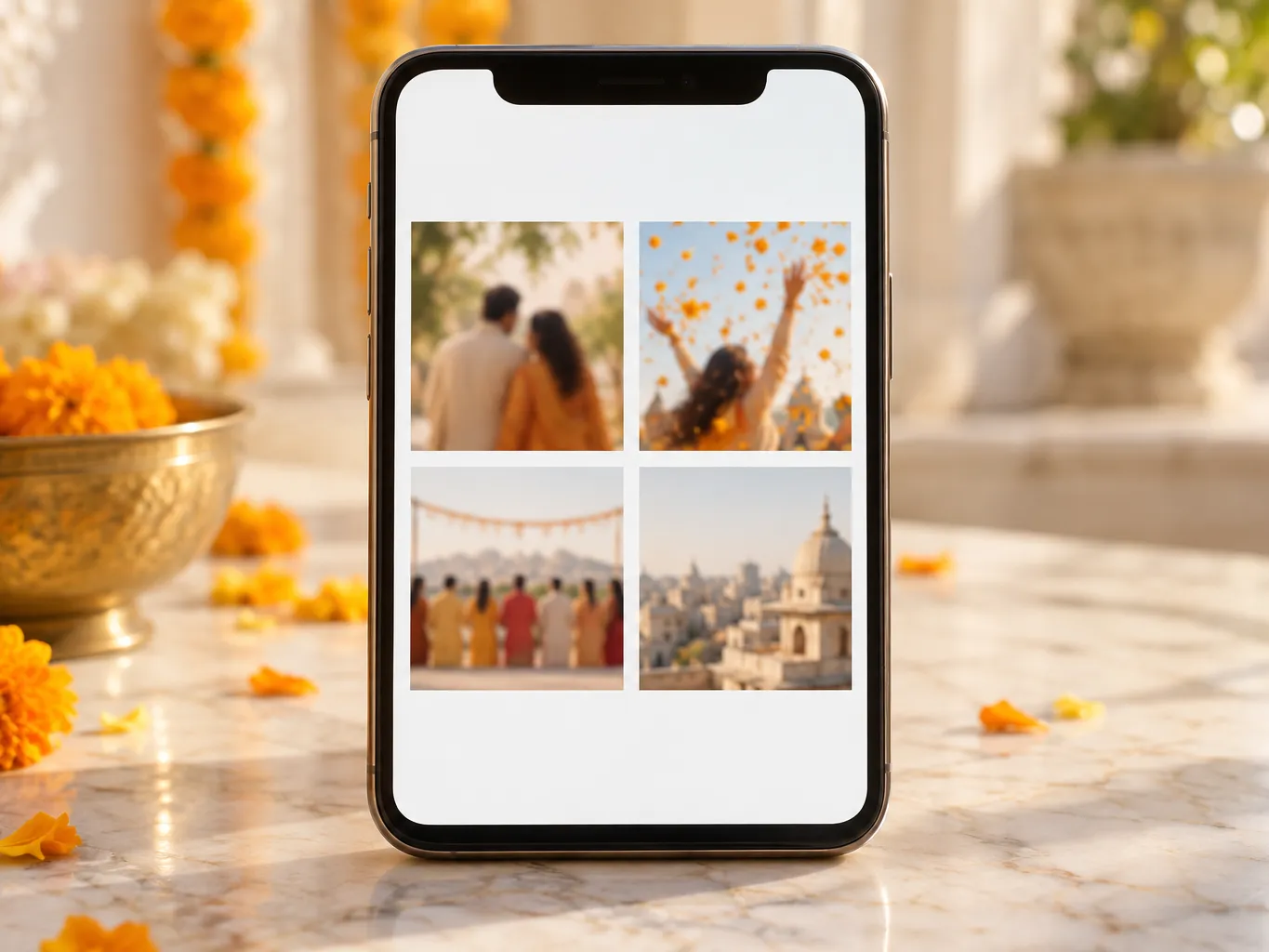
Four in the gallery, which is what ours caps it at, plus your cover photo. More than that and the page gets slow on the 3G a relative is using in a hill station, which is a real constraint and not a design preference.
The harder rule is that they should be different from each other. Four photos from the same shoot, same outfit, same background, are one photo shown four times. Aim for one of you both looking at the camera, one candid, one with family in it, and one of the place if people are travelling to somewhere they have never been.
Keep your best photo off the gallery. Put it on the cover, in a portrait crop, because that is the image doing all the work: it is the first thing a guest sees and it is what shows up in WhatsApp when your link is forwarded.
The RSVP ask
Ask one question that a family of five can answer. "Will you join us?" cannot be answered by a household, which is who your invitation actually went to, so ask how many of them are coming.
Give the date a reason. A deadline with a consequence attached to it gets replies, and a bare date does not. And do not bury the ask behind everything else you wrote. A guest who decided in the first ten seconds should not have to read your whole story before they can say yes.
It would mean a great deal to have you with us. Please let us know by [date] so we can tell the caterers, and do say how many of you are coming.
Replies are the hard part rather than the asking, and there is more on getting guests to RSVP once the invitation is out.
The link preview, which everybody forgets
Before anyone sees a single thing you wrote, they see a card in a WhatsApp chat: an image, a title and a line of text. That card decides whether the link gets opened or scrolled past, and it is editable.
Put your names and the date in the title. Not "Wedding Invitation", which is what a hundred other forwards in the same family group already say. The line underneath should tell someone what tapping gets them.
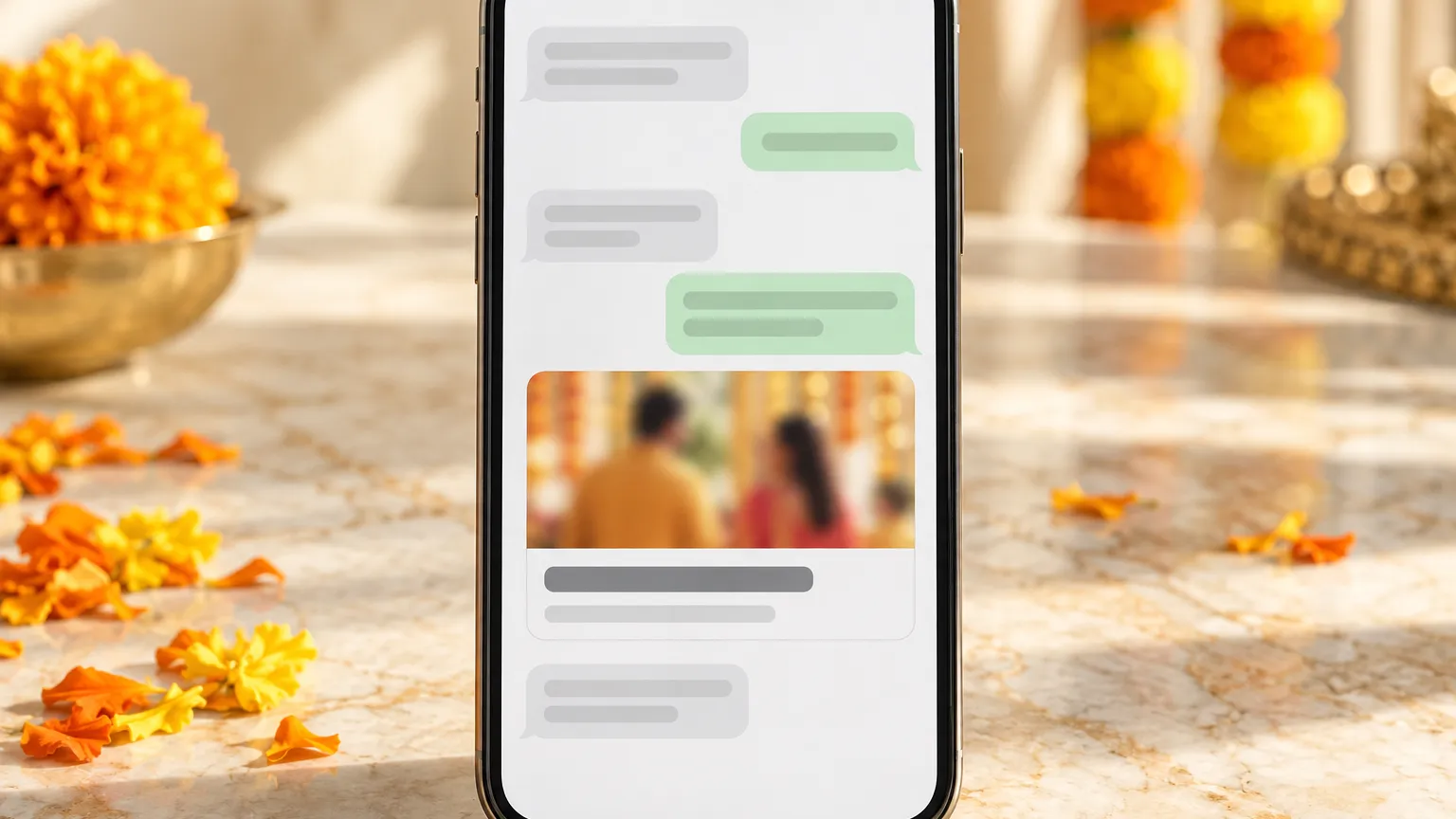
Title: [Name] and [Name] are getting married Message: [Date] in [City]. Tap for all the functions, timings and directions.
The rest of that first message matters too, and sending a wedding invitation on WhatsApp covers what to write around the link.
Before you send your wedding website
Read the whole thing on a phone, out loud, at the speed a person actually reads. You will catch three things immediately: a sentence that is too long, a time that is wrong, and a name spelled two ways.
Then send it to one parent from each side and ask them to check only the names, dates and phone numbers. Not the design. If you ask about the design you will get notes about the design.
Questions people ask
Should a wedding website be in Hindi or English?
Write it in whichever language the family actually reads, and it is fine to mix. Names, blessings and the invitation line often sit better in Hindi or in Devanagari script while timings, directions and the RSVP ask are clearer in English. What does not work is translating everything twice, which doubles the length and halves the chance anyone reads it.
Do we put the full venue address on a wedding website, or just the name?
Name, area and city in the text, then a map link. The address as a paragraph is hard to read on a phone and nobody types it out anyway. The map link is the part that saves you calls, and it is the easiest field to leave empty.
What if the venues are not finalised when we publish the wedding website?
Publish anyway with what you have and add the rest later. Edits after publishing are unlimited on Shagun Studio, and the link you sent stays the same, so a venue added in October appears for everyone who already has the invitation.
Should we mention gifts?
Only if you have something specific to say, and keep it to one line in the guest information rather than a section of its own. A line asking for blessings rather than gifts reads gracefully. A registry link on an Indian wedding invitation still reads oddly to a lot of families, so know your audience before adding one.
How long should a wedding website be?
A guest should reach the RSVP in under a minute of scrolling. If your story section is longer than your events section, the balance is wrong. Everything a guest needs to act on comes before everything that is nice to read.
Do we need a wedding hashtag?
No, but if you want one, decide it before the mehendi rather than after, and put it where guests will see it before the photos start. A hashtag introduced after the first function collects nothing, because everyone has already posted.
Ready to send yours?
Pick a design, add your names and your events, and share the link. Building is free. You pay once, when you publish.
Browse the designs