How to actually get Indian guests to RSVP
RSVP culture never really took here. These are the changes that get you a real headcount before the caterer's deadline.
The caterer wants a number by Tuesday. Your list has three hundred and forty names on it. You have maybe fifty replies, and half of those are some version of "haan haan, aa jayenge, tension mat lo."
That is not a headcount. It is a blessing.
You do not get guests to RSVP by finding a better tool. You get there by asking a different question.
Why Indian guests do not RSVP, and why it is not rudeness
In most Indian families an invitation is not a ticket. It is an honour, and honours do not get replied to. Saying no in advance feels like refusing something, so people say yes, and then decide on the morning based on traffic, a cousin's board exam, and whether the rest of the family ended up going.
The second problem is the word "you". You invite one uncle. Four people arrive, and they are right to, because the invitation went to a household. It always does.
So nagging harder does not work. Asking an answerable question does.
Ask for an RSVP per function, not for the wedding
"Are you coming to the wedding?" gets you "of course, definitely." That is not a lie. It is an honest answer to a question about affection.
"Will you be at the haldi at 10 in the morning on the 14th?" gets you something usable, because now the person has to picture a specific morning and decide whether they will actually be in it.
It is also the only version that helps anyone downstream. Your caterer is not catering "the wedding". He is catering five or six meals of five or six different sizes, and the sangeet number has nothing to do with the pheras number.
If you only have the energy to chase one function properly, chase the one with the smallest room. Twenty extra people at a reception is a longer line at the buffet. Twenty extra people at a house ceremony is a genuine problem, and it is the one your mother will remember. Which function that is falls out of a guest list split by function rather than one list for the whole wedding.
Give the deadline a reason attached to it
"Please RSVP by the 20th" gets ignored, because nothing visibly happens on the 20th.
"We have to release the hotel rooms on the 20th" gets answered, because the guest can see what breaks.
Reasons you can honestly use: the caterer's final count, the date your hotel block expires, seats on the shuttle, chairs at the ceremony, gate passes for a farmhouse that needs names in advance. Use a real one. Inventing a deadline to manufacture urgency is a bad idea in a community this well connected, because families compare notes, and your next deadline will be worth nothing. Both of those cutoffs sit inside a longer sequence, and the invitation timeline lays that out week by week.
Set your date before the real one
WhatsApp reply or a form on the invitation
The two options fail in opposite directions, so this is a real decision rather than a matter of taste.
| A WhatsApp reply | A form on your invitation | |
|---|---|---|
| Works best for | Elders, and anyone who replies to people rather than to pages | Long lists, and any function where you need a number per household |
| What you end up with | Two hundred conversations you read and count by hand | One row per household, with a total that adds itself up |
| Who does the work | You | Them |
| Where it breaks | No running total, and replies buried under photos and forwards | A guest who has never filled a form in her life and will not start now |
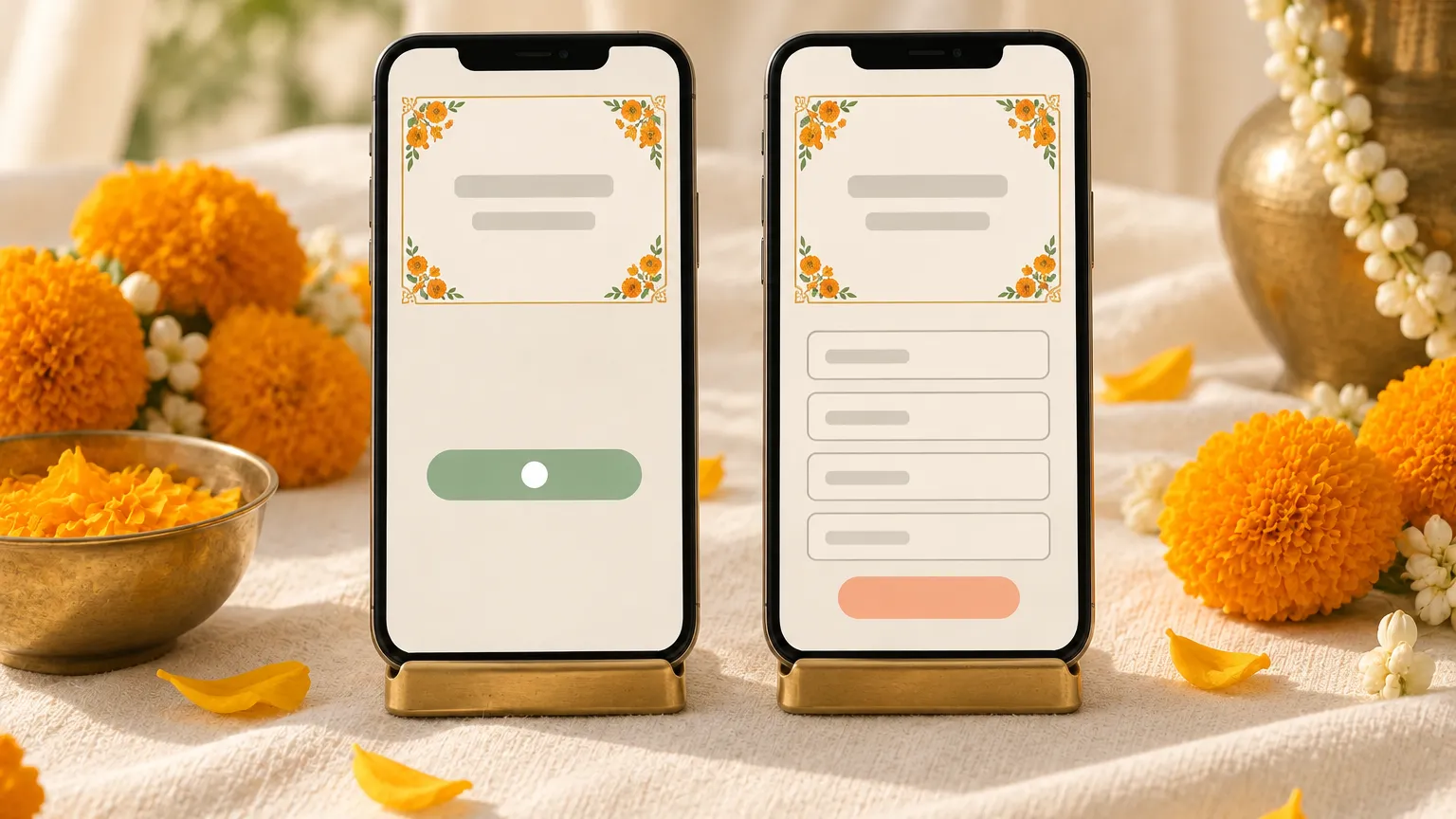
A Shagun Studio invitation carries the RSVP section in one of two modes. Either a WhatsApp button that opens a message already written for the guest, so all they do is press send, or a form on the page itself asking for a name, a phone number, yes or no, how many people are coming, and a note. Form replies land in your dashboard with a running total of guests attending at the top, which is the actual number the caterer asked you for.

Our opinion: turn the form on, and leave the WhatsApp line visible underneath it. The people who will fill a form will fill it. The people who will not are the ones you were going to phone anyway, and at least now they have a button that writes the message for them.
Somebody else should do the chasing
You are the worst person to chase your own guests. A message from the bride is treated as a conversation, not a form. Aunty will reply warmly, at length, about something you did when you were six, and will not mention whether she is coming.
Split the list by circle and give each circle to one person. An uncle for your father's side, a cousin for the friends, one colleague for the office. They already half know the answers. Give each of them thirty names, not three hundred, and give them the link rather than a screenshot of it.
The message that works is not "please RSVP". It is "Aunty, are you coming for the sangeet on the 12th? I have to give the count tomorrow." One person, one function, one date, one reason.
One bit of family politics worth saying out loud: a few relatives find being asked to confirm faintly insulting, as though their presence were in doubt. This is almost entirely generational and it is almost entirely solved by having someone their own age ask. Your mother ringing her sister is a phone call. You ringing your mother's sister is an audit.
The plus ones nobody declared
Indian weddings do not really have plus ones. They have households, and a household is whatever size it is that week: a son back from Bangalore, a widowed aunt who lives with them, the driver who has been with the family for twenty years and is not going to be left in the car.
So stop asking whether someone is bringing a guest. Ask how many of them are coming. It is a friendlier question and a more accurate one, and it is why our form asks how many are coming and not just whether you are. The same household can be four people at the sangeet and two at the pheras, which is the reason the guest list is kept per function rather than as one number.
Then assume you are still under. Ask your caterer what buffer he already builds into the number you give him, and resist adding a second buffer of your own on top, because you will pay for both.
Never put the RSVP in front of the invitation
How many RSVP reminders to send, and when
Three touches, spread out. The invitation itself. One reminder around ten days before your cutoff. A last one two days before, sent only to people who have not replied.
Make reminders carry news rather than repeat the ask. "The mehendi has moved to 4pm" is a message people open. "Gentle reminder to RSVP" is a message people archive, and after the second one it starts to read as pressure rather than planning.
The ones who will never reply
A slice of your list will not answer anyone, ever. Chasing them past the second attempt burns the goodwill of whoever is doing the chasing.
Move them into an assume-yes column and count them as coming. For the large evening functions that is very likely correct, and being wrong in that direction costs you a plate.
For the small functions, skip the form entirely. Twenty five people at the pheras is a phone call list, not a broadcast list. Someone in the family should ring all twenty five over one evening, and at the end of it you will have the only number on your entire spreadsheet you actually trust.
Questions people ask
When should the RSVP deadline be?
Work backwards from whichever real cutoff comes first, and get both dates in writing rather than assuming them. Your caterer will name the day he needs the final count. Your hotel will name the day it releases unsold rooms from your block, and that one is usually much earlier than couples expect. Set your published RSVP date a few days ahead of the earlier of the two so you have room to chase.
Should we ask guests to choose a meal?
Only if you genuinely have two kitchens and the choice changes what gets cooked. At most Indian weddings the spread is the spread, and asking people to pick between chicken and paneer adds a question to your form for no operational gain. Ask about allergies instead, in the free text box, and pass those to the caterer as names.
Do we need to collect phone numbers in the RSVP?
Yes, and it is the field people are most tempted to drop. A name alone gives you a duplicate problem the moment two Sharmas reply. A phone number lets you match a reply to a household on your list, ring the ones who look wrong, and send the venue change to the exact people affected.
A guest replied on WhatsApp instead of the form. Now what?
Enter it yourself in your own list and treat the website count as one input rather than the whole truth. This will happen no matter what you build, and mostly with older guests. It is not a failure of the form, it is how those guests reply to everything.
Is it rude to send a reminder?
No, but a reminder that says nothing new is annoying. Send updates rather than nags. A message that says the mehendi has moved to four in the afternoon gets read, and the RSVP ask can ride at the end of it. Send the last reminder only to people who have not replied.
How do we handle relatives who do not use smartphones?
Somebody in the family calls them, and that somebody should be their own generation. Keep a short list of the people who will always be phoned rather than messaged, hand it to one person, and count those replies into your total by hand. Ten phone calls is an evening. It is also the most reliable data you will get.
Ready to send yours?
Pick a design, add your names and your events, and share the link. Building is free. You pay once, when you publish.
Browse the designs