Digital wedding invitation cost in India: what you pay
The same sentence can cost you nothing or many thousands of rupees. Here is what you are actually paying for, and which parts of the bill are pure markup.
The same fifty words, your names, four dates and two addresses, can cost you nothing or many thousands of rupees. That spread is not about quality. The digital wedding invitation cost in India is not one number, it is five different purchases wearing one name, and most quotes are written specifically so you cannot tell which one you are looking at.
The five things people mean by a digital wedding invitation
Before the numbers, sort the category, because half the confusion in these quotes comes from comparing an image file to a hosted product.
A static e-card is one image or PDF, your details typed into a designer's layout. A video invite is thirty to ninety seconds of animation, usually a template scene with your names placed into it. DIY means you open a design tool and do it yourself. A wedding website is a hosted link that holds every function, directions and RSVPs. Custom development means somebody codes a one-off site for you, which almost nobody planning a wedding should be doing. If you are stuck between the three most couples really choose between, the PDF card, video invite and website comparison is the shorter read.
| What you are buying | Price band seen |
|---|---|
| Static e-card, template layout | About Rs 50 to Rs 600 a design |
| Video invite from a studio catalogue | About Rs 500 to Rs 7,000, depending on length and how much is drawn rather than reused |
| Video invite made to order, original artwork | Quoted per project, well above catalogue work. Several studios in this bracket publish no price list at all. |
| DIY in a design tool | Free on the free tier, or an annual subscription for the paid one |
The figure that circulates most is not on that table, and that is deliberate. Budget guides written to help you plan a whole wedding put the invitation line well above what a studio catalogue actually charges, because they are planning tools rather than price lists. If a vendor quotes you a five-figure sum for a digital invitation and points at a budget guide as justification, ask what specifically you are buying that a catalogue does not already sell for a fraction of it.
What legitimately makes it expensive
A few things move the price honestly, and each of them is somebody's labour rather than a line on a rate card.
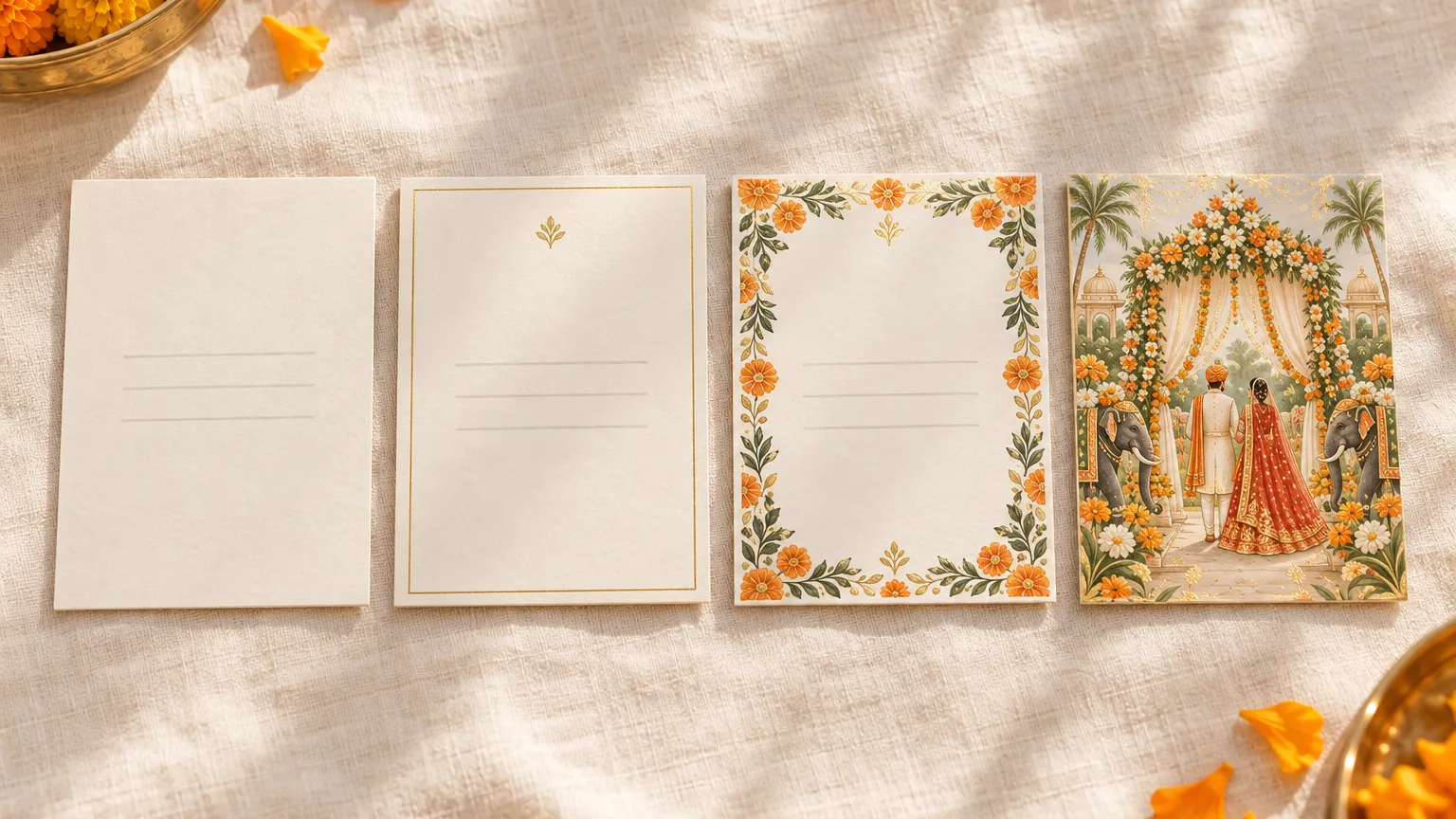
Original illustration is the big one. If an artist draws you and your partner rather than placing your faces into an existing character rig, that is real work, and it is priced like real work. Worth it if you care about the artwork. Pointless if you will watch it twice.
Seconds of animation are the second. Animation is priced by duration because it is produced by duration. A ninety-second film with four function scenes costs more than a thirty-second one for the same reason a longer taxi ride costs more, and there is nothing shady about it. What is shady is being quoted for ninety seconds and delivered a thirty-second loop.
Per-guest personalisation is the third, and it is where budgets quietly go wrong. Having each guest's name rendered into a video means rendering the video once per guest. Two hundred guests is two hundred renders, and studios price that per name because it costs them per name. On a website the same effect is a link with a name in it, which costs nothing, so check whether you are paying for a hard problem or an easy one dressed up.
Which parts of the cost are pure markup
A permanent discount is not a discount. If a listing has carried the same struck-through price for months, the lower number is the price and the strike-through is decoration. This is completely normal in Indian e-commerce and we do it too. Just do not let it hurry you.
Countdown timers are worth even less. A clock on an invitation page is decoration until you have watched the price actually go up, and on a product you buy once it almost never does.
Charging separately for the couple's monogram, a hashtag and a thank-you page is unbundling, not craft. Those are short design jobs sold as separate products. If the extras add up to more than the invitation, you are looking at a pricing strategy, not a product. What to ask before any of this is settled is in how to choose a wedding website builder.
Ask one question before you pay
The costs nobody puts in the quote
Edits are the first and the largest. Studios deliver a preview and count revision rounds after that, and the number included is finite even where nobody prints it. Ask what it is before you pay, and read the answer as a budget, because it is one.
Watermarks are the second. Free invitation makers are usually free until the download. On the e-card sites the gallery is a mix of free designs and paid ones from a few tens of rupees up, and the ones you will actually want are on the paid side. That is a fair business model. It is just not a free invitation.
Domains are the third, and this one is close to a pure upsell. Builders that sell you a custom domain charge an annual fee for it and will happily let you keep the free link instead. Your guests are going to tap a link in WhatsApp. Not one of them will type your domain.
The fourth is the one nobody thinks about until it happens: how long your invitation stays online, and what happens after. Ask. A link that goes dark six months after the wedding takes your photographs and your RSVP list with it.
Where we sit, including the part that is not special
Building on Shagun Studio is free. You choose a design from the collection, fill in every function, upload your photos and watch the whole invitation on your own phone without paying anything, and you pay once when you decide to publish. Switching to a design that costs the same or less afterwards costs nothing, and moving to a pricier one only charges the difference.
We used to describe pay-on-publish as unusual. It is not, any more, and that is a good development for couples. So we will claim the narrower thing that is actually true: every edit after you publish is free, forever, right up to your wedding day. Not two rounds. You change the sangeet venue at eleven at night, four days before the function, and it costs nothing and takes a minute.
The parts we would want you to know before paying: your invitation lives on a shagunstudio.com subdomain and we do not sell you a domain of your own, the link stays live for one year from the day you publish, and editing closes the day after your wedding date. If any of those is a problem for you, it is better to know now than at checkout.
A budget that survives contact with an actual wedding
If your total invitation budget is under Rs 2,000, buy one good thing rather than three cheap ones. A single well-made e-card beats a bad video plus a bad website.
Between Rs 2,000 and Rs 6,000 you can have both formats: a catalogue video invite for the announcement and a website for everything guests will ask afterwards. This is where most Indian couples with three to seven functions get the best return, because the second purchase is buying you fewer phone calls rather than more artwork. What belongs on that second thing is a list of its own, and the wedding website content checklist has it.
Above Rs 15,000, you are commissioning art. That is a real thing to want and some couples want it badly, particularly for a save-the-date that goes on Instagram. Just decide that you want it, rather than arriving there through add-ons.
And whatever you buy, get the edit policy in writing before you pay. Regret in this category is rarely about the design somebody picked. It is about what it cost to change one line in it a fortnight before the wedding.
Questions people ask
Why do quotes for a video invite vary so much?
Two things drive it. Whether the artwork is drawn for you or reused from a template the studio already owns, and how many seconds of animation you are buying. A catalogue scene with your names typed in is cheap. Hand-drawn caricatures over custom animation is a week of somebody's labour.
Is per-guest personalisation worth paying for?
Rarely at video prices, because you are paying a render fee per name for something people watch once. It is worth having when it comes free, which is how per-guest links on a website work.
What are the hidden costs of a digital wedding invitation?
Edits, mostly. Studios quote a delivery price and count revision rounds separately, and website builders often sell design changes as add-ons after purchase. Ask the number before you pay, not after your venue changes.
Do I need to buy a domain name?
No. Most builders host your invitation on their own address for free and sell a custom domain as an upgrade. It is a vanity purchase. Guests tap a link, they do not type it.
Is a free invitation maker good enough?
For a birthday, yes. For a wedding, the free tiers almost always watermark the output or lock the good templates, so you end up paying anyway, just later and with less choice.
How much should I budget for a wedding invitation in India?
For most Indian weddings, a few thousand rupees total covers a digital invitation properly, whichever format you choose. Well above that you are buying bespoke artwork, which is a legitimate thing to want and a bad place to make savings if you did not want it in the first place.
Ready to send yours?
Pick a design, add your names and your events, and share the link. Building is free. You pay once, when you publish.
Browse the designs