Video invite vs wedding website vs PDF: which to send
A PDF, a video invite and a wedding website each fail at something different. Which one fails at the thing you actually care about?
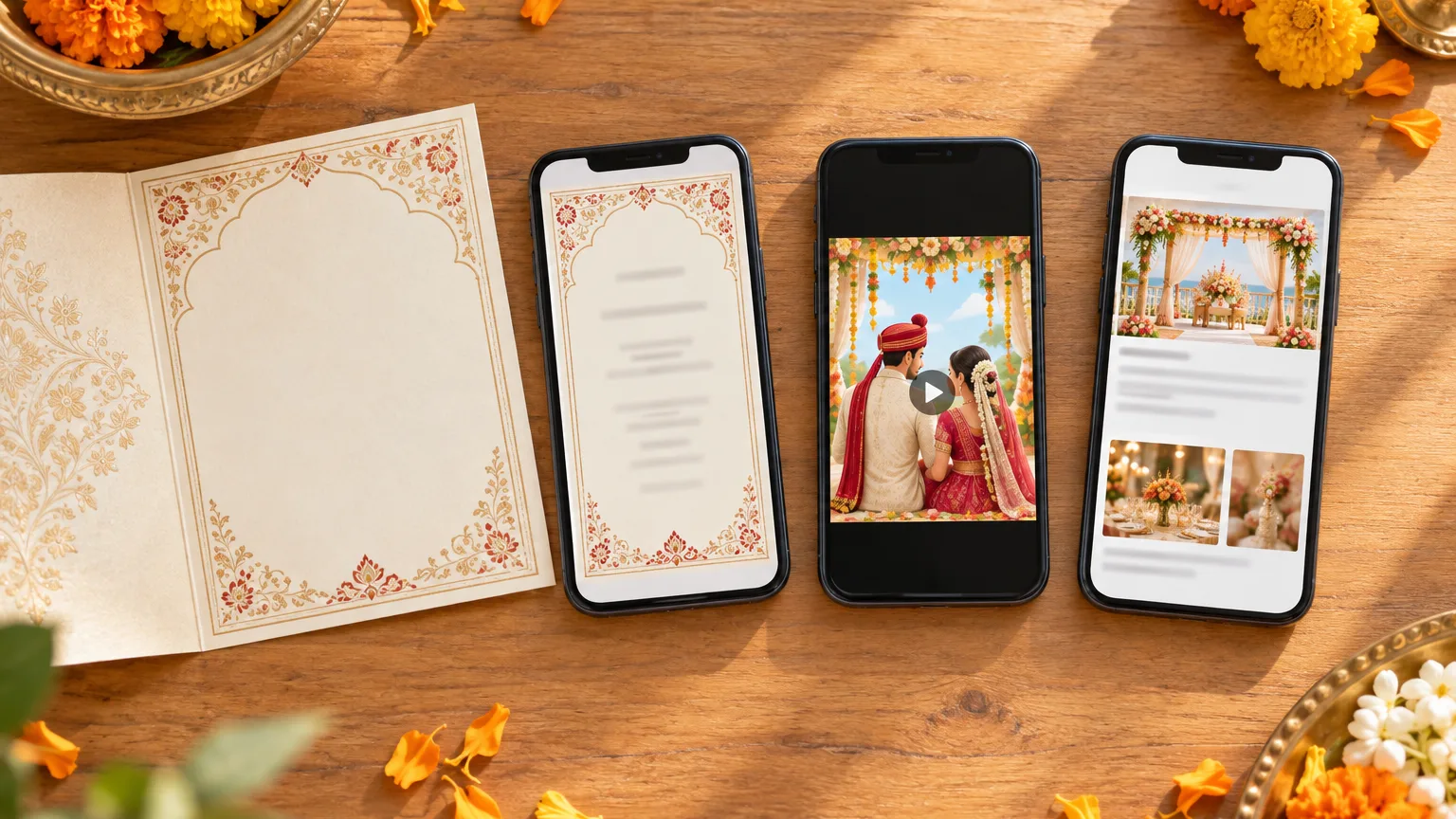
Three different products get called a digital wedding invitation in India, and they are not versions of the same thing. A PDF is a picture of a card. A video invite is a short film. A wedding website is a page that keeps working after you have sent it. Plenty of couples choose one, pay for it, and only then find out what it cannot do.
We build wedding websites, so weigh the last section accordingly. The rest of this is written to be useful even if you decide against us, because two of these three formats do something a website genuinely cannot.
What each one actually is
The PDF is usually the artwork your card printer already made, exported as a file. Sometimes it is the only digital thing the card shop hands over. It was laid out for a folded piece of paper roughly the size of your hand held at reading distance, and that assumption follows it everywhere.
The video invite is a commissioned piece of animation, often with caricatures of the couple, a template scene set behind them and your names, dates and venues typed in. Studios sell these from a catalogue, where a simple caricature invite and a fully custom animated love story are very different orders.
The wedding website is a link. Your functions, addresses, map pins, dress code, the wifi password at the hotel, who to call when the cab driver gets lost, and a form your guests can reply on. It is the only one of the three that can change after you have shared it.
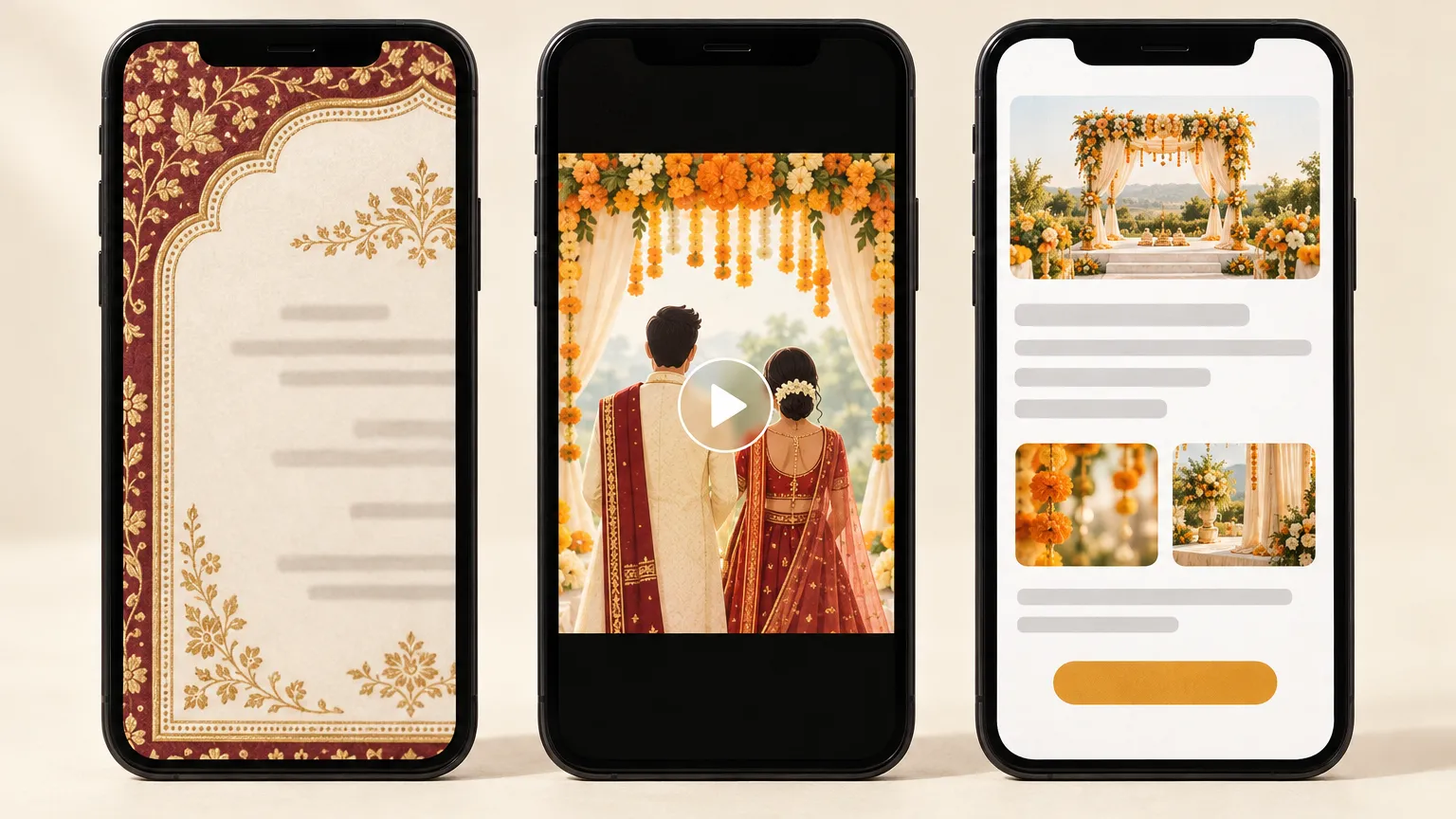
PDF card vs video invite vs wedding website, compared
| PDF card | Video invite | Wedding website | |
|---|---|---|---|
| What your guest receives | A file | A file | A link |
| Time to get it | Same day if the artwork exists | A few working days for a first preview from a studio, plus edit rounds | An evening, if you have your details ready |
| Holds more than one function cleanly | Cramped | Yes, but the video gets longer | Yes |
| Collects RSVPs | No | No | Yes |
| Directions and a tappable map link | A printed address | A printed address | Yes |
| Works with no signal | Yes, once downloaded | Yes, once downloaded | No |
| Changing it after you have sent it | You send a second file and hope | You go back to the studio and send a second file | You edit it and every link already shared updates |
| Where it fails | Unreadable on a phone without pinching | Plays once, then you scrub back to reread the address | Feels like a webpage unless the opening is designed well |
Price is the one column that table leaves out on purpose. All three are quoted differently, by different kinds of seller, and a range typed into a comparison goes stale quietly. What each format costs is its own question, answered in what a digital wedding invitation costs in India.
What happens on a four-year-old Android
This matters more than anything on the design brief. Some of the people on your list are on a budget handset a few years old, with a full gallery and almost no storage left, and they are not going to upgrade it for your wedding.
The PDF opens. It always opens. Then your guest pinches and drags around a page that was typeset for A5 paper, and the venue address, set tiny because a delicate script looked elegant on card, becomes a few grey pixels. Nobody complains about this. They just stop reading and phone your mother instead.
The video has to download before it plays anything. On a train, on rural 4G, in a basement office, it stalls. If auto-download is switched on, and on most phones it is, the file then parks itself in the gallery and stays there forever. And a video is linear: to check the sangeet address for the third time, you scrub back through the animation and pause on the right frame.
A website loads in pieces, so text appears before pictures do, which is the behaviour you want on a weak connection. But a badly built one is the worst of the three. If a builder ships a heavy background video, three animation libraries and photos nobody resized, that page will stutter on an old phone and drain a battery. That is not a website problem. That is a bad website.
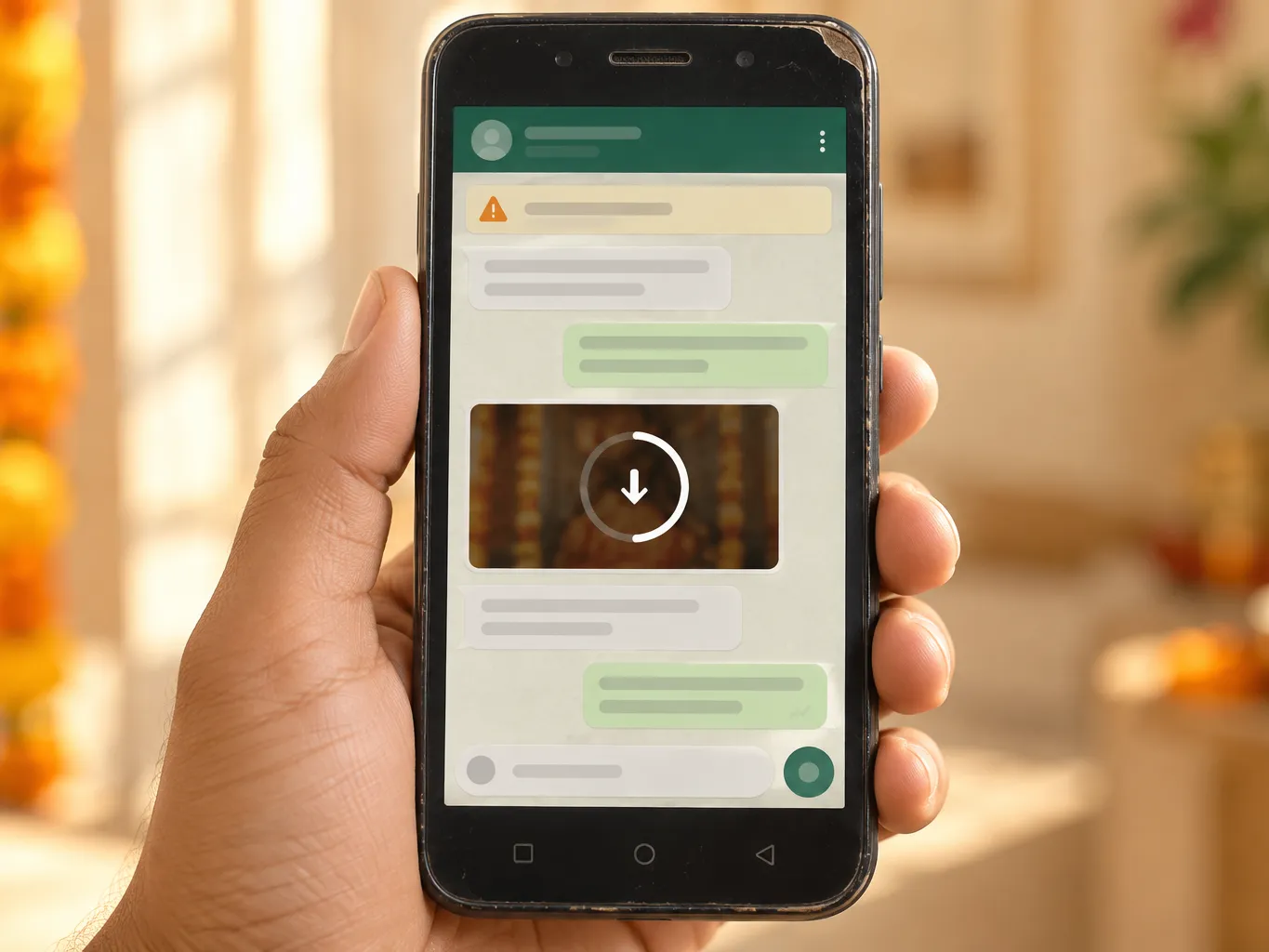
Test it on the worst phone in your family
What a seventy-year-old does with a PDF, a video invite and a website
Video wins here and it is not close. It arrives in the chat, there is a play triangle, and the entire interaction is one tap on something people have been tapping for a decade. No browser, no scrolling, no decision. If your only priority is that your grandmother sees it and forwards it to her sisters, a film in the chat is the shortest path, and a link will never be shorter than one tap.
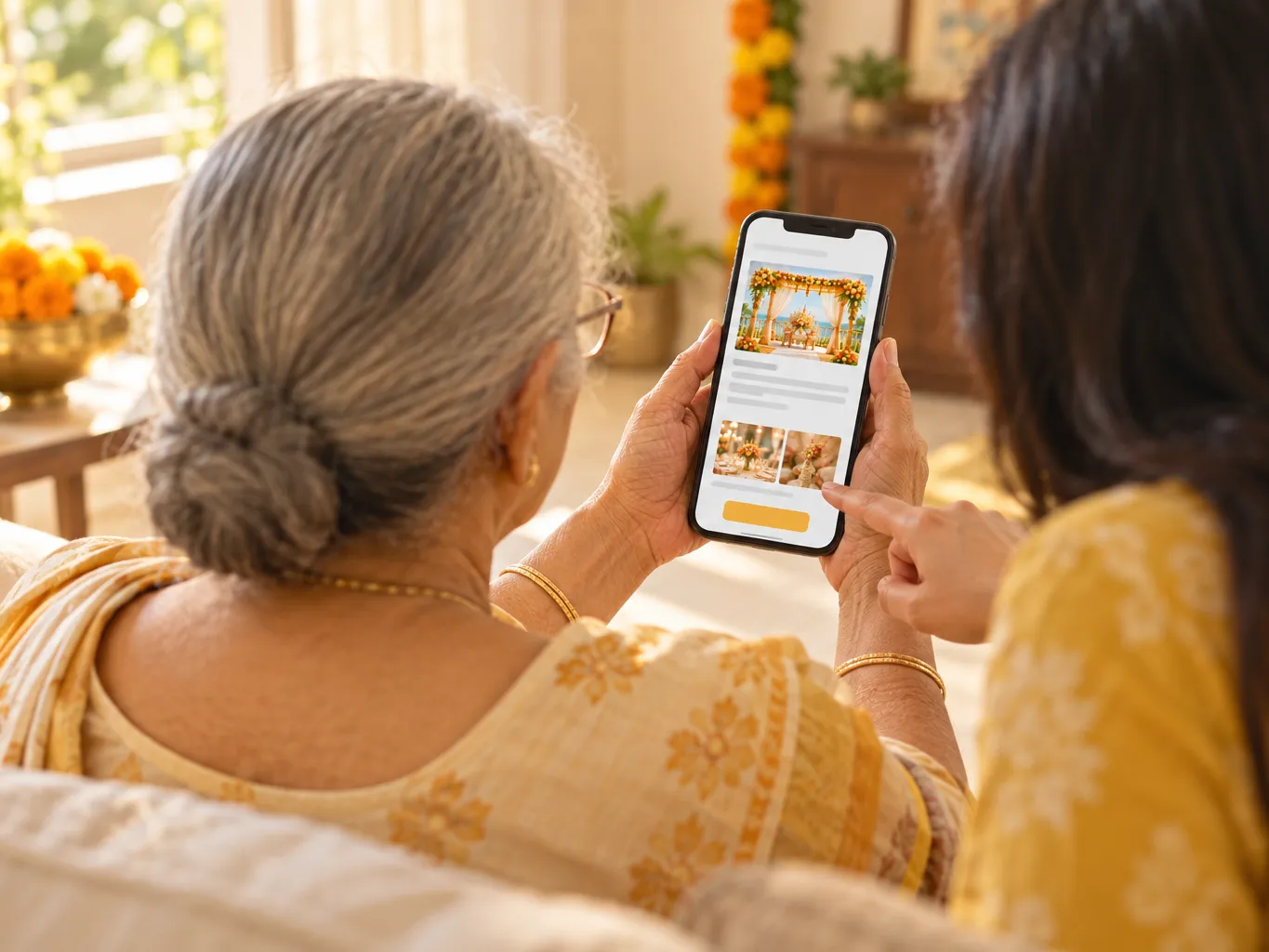
The PDF comes second. Almost everybody has opened a PDF before, usually a bank statement. It opens in a viewer, it takes a moment, and then it is a picture that needs zooming.
The website has one real obstacle, and honest builders should admit it: the tap out of WhatsApp. Your guest is inside a chat, and a link takes them somewhere else. Whether they stay depends entirely on the first screen. If it opens with a nav bar, a cookie notice and a heading, they have seen a thousand of those and they close it. If it opens with something that behaves like an invitation, they stay. That first screen, and the preview card above it, are most of how you send a wedding invitation on WhatsApp without it looking like a forward.
Which is why the opening is the whole argument for the format. Our designs start closed and ask for one small gesture, the way a real card asks to be lifted out of its envelope. Ambari holds its palace doors shut with a brass chain latch the guest drags aside. It is a small thing and it is the difference between a link and an invitation.
The venue changes two weeks out
Nobody writes about this and it decides the argument. Something moves. A banquet hall double-books your date, a farmhouse loses a licence, the rain shifts the mehendi indoors, the pandit moves the muhurat by ninety minutes, a hotel block falls through and forty outstation guests need a different address.
With a PDF you send a second file. Now two files exist across four hundred chats, and the wrong one keeps getting forwarded, because a forwarded invitation is the one somebody saved, not the one you sent last. Half your family will arrive at the old address. You will spend the week before your wedding on the phone correcting it.
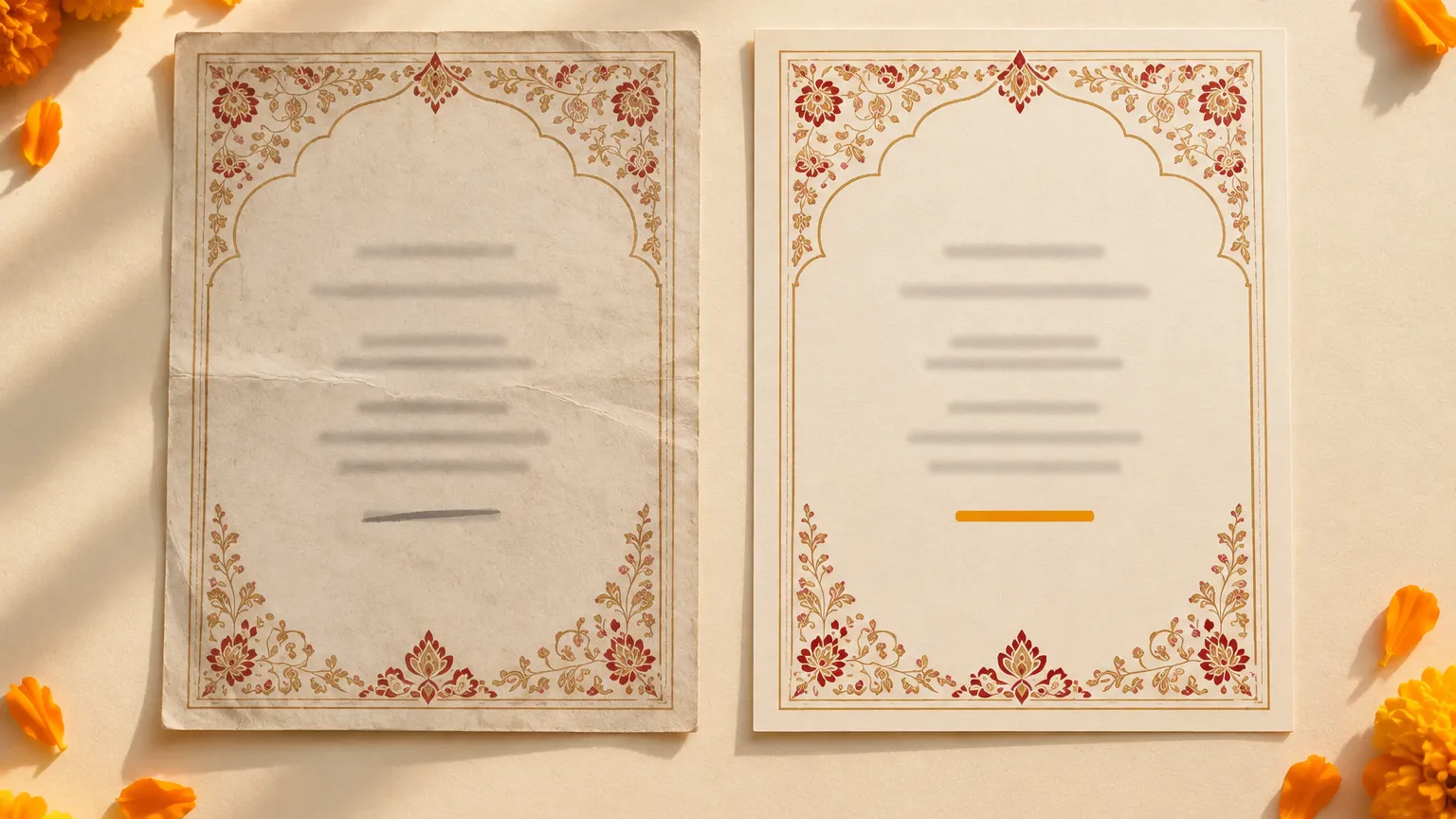
With a video it is worse, because you cannot fix it yourself. You go back to the studio, you wait in their queue, and you may pay for it. Revision rounds are usually counted and usually finite, so a change you did not plan for competes with the edits you were saving for the artwork. Then the new file goes out and the old one is still sitting in everyone's gallery, auto-downloaded, indexed, looking exactly as official as the correct one.
With a website you open the builder, change the address, and every link you have already shared now shows the new one. The message your cousin forwarded three weeks ago updates itself, because a link points at the current truth rather than carrying a copy of an old one. Nobody has to be told twice.
The honest caveat: if a guest screenshotted your venue page, they have a stale screenshot, same as a stale PDF. But a screenshot is one person's copy. A forwarded file is a copy that keeps reproducing.
What a website is genuinely worse at
It needs a connection. It is a link, which is less tactile than a file people can save. It cannot be printed and put in a puja thali. It does not autoplay in a family group the way a video does, so it will never have that moment where four aunts reply with hearts within thirty seconds. And if the design is generic, the whole thing collapses, because a plain wedding website is genuinely less charming than a well-made card.
There is also a decent chance somebody in your family will say it does not feel like a real invitation. They are not being difficult. They mean the thing they receive should feel considered, and a link, by default, does not. The fix is not to argue. The fix is to send them something that opens beautifully.
So which one
If you have one function, at one address, on one day, and a guest list that lives entirely inside WhatsApp, a website is more machinery than that wedding needs. A single card does it.
If you have three or more functions, or guests coming from outside the city, or a mehendi venue that half your family has never heard of, the website is the one that saves you actual work. Not because it is prettier. Because the logistics of an Indian wedding are the expensive part, and only one of these three formats can hold logistics that change. Working out who is invited to which function is the other half of that job.
And if you can spend on both, the sequence that works is a film for the announcement, sent to the family group where it gets played and forwarded, with the website link in the same message. The film does the feeling. The link does the fifty questions that come afterwards.
The one combination we would argue against is a PDF on its own for a multi-day wedding. You will spend more time answering "beta, sangeet kahaan hai" on the phone than the website would have cost you.
Questions people ask
Can I send a video invite and a wedding website?
Yes, and for most families that is the right answer. The video is the announcement, the website is where the details live. Put the link in the same message as the video so nobody has to hunt for it later.
Do older relatives actually open a website link?
They open it if the first screen looks like an invitation instead of a webpage. The failure case is a link that opens into a wall of headings and a menu bar, because that reads as advertising and gets closed in a second.
Is a PDF invitation unprofessional?
No. A PDF of a beautifully printed card is a perfectly respectable thing to send. It is just a picture, so it cannot hold RSVPs, directions or an updated venue, and it was laid out for paper rather than for a phone screen.
What happens to a video invite if the date changes?
You go back to the studio, wait for a re-render and send a second file. Everyone who already downloaded the first one still has it in their gallery, and there is no way to reach into their phone and replace it.
Will a wedding website work if my guests have no internet at the venue?
No, and neither will the WhatsApp message carrying your PDF. Guests who need directions in a patchy signal area should screenshot the address the day before, which is what most people do anyway.
Is a wedding website worth it for a small wedding?
It depends on how much of your wedding is logistics. Three or more functions across more than one address, or guests travelling in, and the website earns its keep, because the coordination is the expensive part of your wedding rather than the artwork. One function at one venue, with a family that never leaves WhatsApp, is less machinery than a website is built for.
Ready to send yours?
Pick a design, add your names and your events, and share the link. Building is free. You pay once, when you publish.
Browse the designs